Car battery replacement
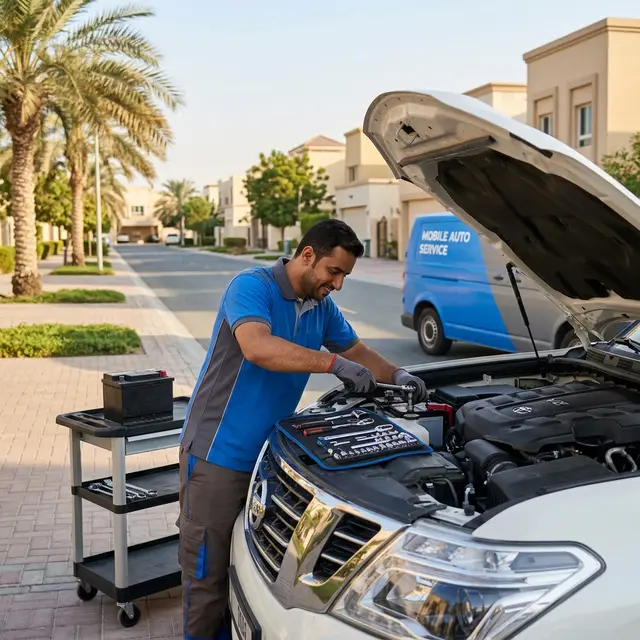
A new battery matched to your car, delivered and fitted on site with the BMS reset and the old unit recycled.
- AGM, EFB and flooded in stock
- Warranty up to 24 months
- Old battery taken away
Questions
The questions drivers in Dubai, Abu Dhabi and Sharjah ask us most, with short direct answers.
A technician usually reaches you in 20 to 35 minutes anywhere in Dubai, and the fitting itself takes about 15 to 25 minutes including the battery monitoring system reset.
The Velar has start-stop, so it uses an AGM battery. The exact capacity depends on the engine and model year, so we confirm it from the label on your current battery or from the VIN before the van leaves.
Yes. The battery monitoring system should be reset so the car knows a new battery is fitted and charges it correctly. Our technicians do this on site as part of the fitting.
Yes. We use service cars and compact vans that fit standard basement height limits. Tell security a technician is coming and send us the level and bay number.
Yes. Dispatch runs 24 hours a day, seven days a week, including Fridays and public holidays.
New batteries carry a warranty of up to 24 months, depending on the brand and model you choose. The term is written on your invoice.
You can pay by cash or card on site, or split the bill into instalments with Tabby or Tamara.
Yes. If the battery is only discharged we jump start it and test it. If the test shows it will not hold charge, we tell you and you decide whether to replace it.
All of Dubai, Abu Dhabi city and its suburbs, and Sharjah. The service areas page lists every neighbourhood.
We take it with us and hand it to a licensed recycler. Used lead-acid batteries are hazardous waste and should never go in a normal bin.
Drive for at least 30 minutes without stopping the engine. A battery that was only discharged will recover. One that is worn out will be flat again by morning, which is why we test it before leaving.
Yes, when it is done with a surge-protected booster and the correct connection points. Jumping from another running car with cheap leads is what causes voltage spikes.
Then the battery has usually failed completely, or the fault is the starter or alternator. The technician tests on the spot and can fit a new battery or arrange recovery.
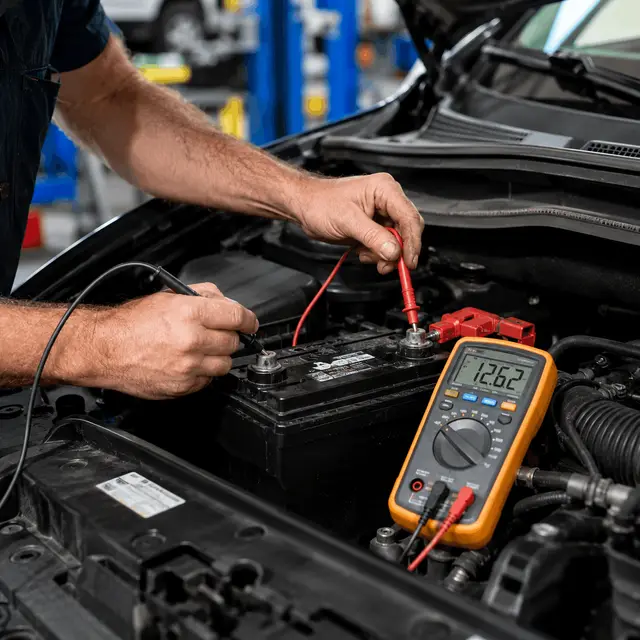
About 12.6 volts at rest with the engine off. Below roughly 12.2 volts it is low on charge, and with the engine running you should see about 13.7 to 14.7 volts from the alternator.
Once a year from the second year, ideally in April or May before the heat peaks. Summer is when weak batteries fail.
Yes. The battery is judged with the engine off and the alternator with it running, so the two results point to different parts.
No. A car designed for AGM charges at a profile a flooded battery cannot handle, and stop/start cycles will wear it out in months. Replace AGM with AGM.
AGM copes with heat and deep cycling better than a flooded battery, so it usually sits at the upper end of the two to three year range, and longer with covered parking.
EFB is a strengthened flooded battery for basic start-stop cars. AGM holds its electrolyte in glass mat, handles deeper discharge and suits cars with heavy electrical loads. An EFB car can move up to AGM, never the reverse.
No. A car designed around AGM will wear out a flooded battery quickly, and the charging system is set up for AGM. Stop/start faults and early failure are the usual outcome.
Yes, once the engine is running the alternator supplies the car. The risk is the next start, so avoid switching off somewhere awkward until the battery has been recharged or tested.
Read the label on the battery. It will say AGM, VRLA or Absorbent Glass Mat. If you cannot reach the battery, send us the make, model and year or the VIN and we will confirm it.
Not by much. A premium battery of the correct type usually holds up better, but heat still limits every brand to roughly the same 2 to 3 year range. Correct specification and a healthy charging system make a bigger difference.
Yes. Undercharging leaves the battery flat and sulphated, and overcharging overheats it. That is why charging voltage is checked whenever a battery is replaced.
Yes. The service runs 24/7 and typical arrival is 20 to 35 minutes. At night the main delay is usually the gate, so let security know in advance.
Check the owner's handbook for your model before you do. Acting as a donor exposes the car's electronics to the same spikes, and some manufacturers advise against it on certain models.
A premium AGM battery in the correct size, most often from Varta or Bosch. The exact specification depends on the model, engine and year, and the technician confirms it from the battery label or the VIN.
Because the correct battery differs by car, engine and year, and a list would be wrong for many of them. A quote based on your actual car is quicker and accurate.
No. A flat battery contains the same lead and acid as a charged one. It is hazardous waste and belongs with a licensed recycler.
Most call-outs end with one of these. The technician tests first, so you only pay for what the car needs.
A new battery matched to your car, delivered and fitted on site with the BMS reset and the old unit recycled.
A protected boost that will not spike the electronics, followed by a test to tell you whether the battery will hold.
A digital conductance test of battery health, cranking power and alternator output, with a printout you can keep.
Send your location and car model. A technician is usually with you in 20 to 35 minutes.
No call-out surprises. You get the quote before we move.