The "Low Battery Please Start Engine" message means the car has measured the 12V battery charge as too low to keep running the electrics with the engine off. Start the engine and drive for at least 30 minutes so the battery can recharge. If the message keeps returning, have the battery and the monitoring sensor on its terminal tested, because the cause is not always the battery itself.
What the warning actually means
The message is a request, not a fault code. A sensor on the battery terminal reports charge level to the Battery Monitoring System (BMS). When the level drops below a set threshold with the engine off, the car asks you to start the engine so the alternator can take over.
It appears most often when you sit in the car with the ignition on, listening to the radio or waiting with the air conditioning fan running. If you ignore it, the car starts shutting down comfort features to save enough charge for a restart.
Common causes
Most cases come down to a battery that is not getting enough charge or can no longer hold it. A smaller number are caused by the monitoring hardware or software giving the car the wrong picture.
- Short trips. A ten-minute school run does not replace the charge used to start the engine and run the cabin electrics.
- Long parking. A Range Rover left for two or three weeks, at the airport or over the summer, loses charge to its alarm and control modules.
- An ageing battery. In UAE heat, 2 to 3 years is a typical life, and capacity falls well before the car refuses to start.
- A loose battery monitoring sensor clamp on the terminal. JLR service bulletins list this as a known cause on several Range Rover models.
- Software. On some 2014 to 2017 Range Rover and Range Rover Sport models the warning has been linked to software, which a dealer or specialist can check and update.
- A charging fault or a parasitic drain, where something keeps drawing current after the car is locked.
Why stop/start becomes unavailable
Stop/start is the first feature the car withdraws when the battery is low. The system will only stop the engine if it is confident the battery can restart it. A low state of charge fails that check.
That makes stop/start a useful early indicator. If it has not worked for weeks in normal driving, the battery is either undercharged or losing capacity. In the UAE the system also stays off when the air conditioning is working hard, so judge it on a mild evening, not at midday in August.
What to do when it appears
Start the engine straight away. Waiting only lowers the charge further, and a Range Rover that drops too low may not crank at all.
- Start the engine and switch off loads you do not need, such as heated or cooled seats and rear screen demist.
- Drive for at least 30 minutes at normal road speeds. Idling in the car park charges slowly.
- Note when the message appears: after a long park, after short trips, or every time you stop.
- If it returns within a few days, book a battery and charging test before the car leaves you stranded.
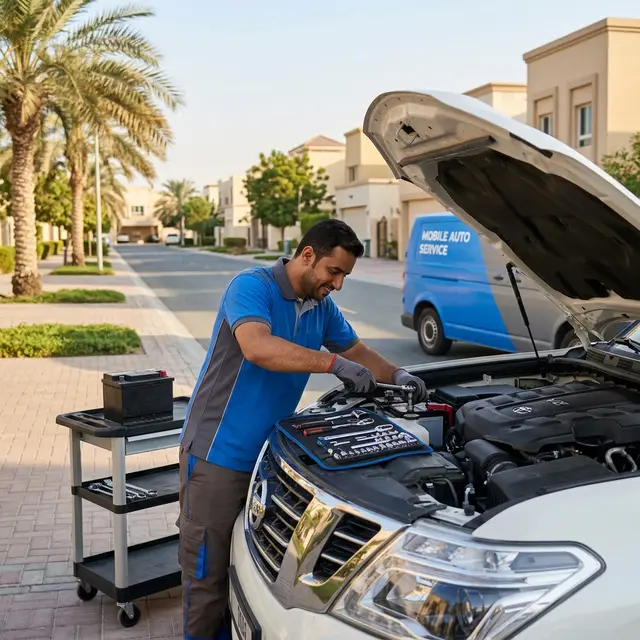
- If the engine will not crank, call for a jump start and have the battery tested during the same visit.
When a new battery will fix it, and when it will not
A new battery fixes the warning when the test shows the old one has lost capacity. That is the usual finding on a battery more than two years old in this climate. The replacement must be the correct AGM type, and the BMS must be reset afterwards or the warning can come back.
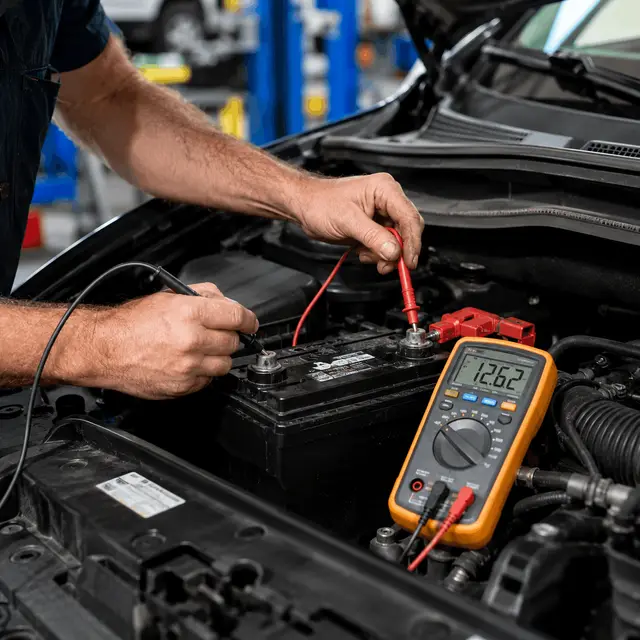
A new battery will not fix a loose sensor clamp, outdated software, a weak alternator or a parasitic drain. In those cases the new battery simply goes flat as well. This is why we test before we replace, and why the technician checks the sensor clamp and the charging voltage on every Range Rover visit.
Related pages
- Car Battery Testing
- Land Rover battery replacement
- Car Jump Start Service
- Battery or Alternator? How to Tell Which One Has Failed
- Range Rover Velar Battery Replacement: What Owners Should Know
- AGM vs EFB vs Flooded Car Batteries: Which One Does Your Car Need?
- How Long Do Car Batteries Last in UAE Heat?